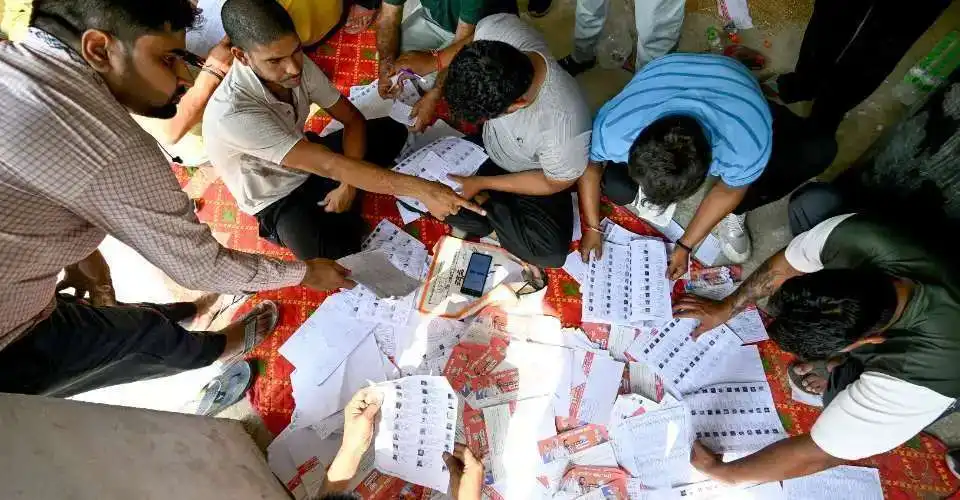
The ruling BJP’s electoral overhaul threatens the democratic core of the nation
Election Shadow
A massive 174 million people are voting this month and in early May in the states of West Bengal, Assam, Kerala, Tamil Nadu, and tiny Puducherry to choose representatives for 824 seats in their legislative assemblies.
However, the process has already come under a shadow, with doubts cast on the neutrality of the powerful Election Commission conducting the polls.
The election results are due on May 4.
Allegations of Disenfranchisement
The commission, and in particular the handpicked Chief Election Commissioner, Gyanesh Kumar, has been accused by the combined Opposition of favoring Prime Minister Narendra Modi’s Bharatiya Janata Party even before polling day by deleting tens of millions of voters from electoral rolls.
In the state of West Bengal, where the BJP is seeking to unseat the three-term Trinamool Congress Party government of incumbent Chief Minister Mamata Banerjee, more than 6.37 million names have been struck off the rolls, most of them said to be Muslims.
Muslims are accused by Modi’s government of being infiltrators from neighboring Bangladesh, whose entry has allegedly been facilitated by Banerjee in West Bengal. The deletions may well change the results in several constituencies won last time by the Trinamool Congress Party.
Hundreds of thousands of people, many of whom are said to be Muslims, have also been expunged from the voters’ list in Assam, which also has a long border with Bangladesh and is already ruled by the BJP after decades of Congress rule.
The international borders are only partly fenced, and are seen as very porous in the riverine plains of the Brahmaputra and the Ganges rivers as they flow into Bangladesh and the Bay of Bengal.
Campaign Polarization
The BJP has but a marginal presence in the other three states in the south, though it is bidding to work through coalitions to unseat the regional party, Dravida Munnetra Kazhagam in Tamil Nadu, and the Marxist party-led Left Democratic Front in Kerala.
Islamophobic rhetoric has rung loud and acrid in the election campaign of the BJP in West Bengal and Assam. In the southern states, Modi and his senior campaigners pick not on Muslims, but on local issues as they seek a foothold in assemblies where they have minimal or no presence.
Opposition parties speak openly of a “Great Vote Heist” — a constellation of pre-election measures they say are designed to disenfranchise tens of millions of Muslim voters, install an informal brand of president’s rule via the central overhaul of police and bureaucracy.
This shall set the stage for “One Nation, One Election,” or simultaneous national and state polls, framed by Modi as an agenda item of national integration but read by critics as a bid to entrench the BJP’s dominance in a synchronised electoral future.
Commission Under Pressure
Opposition leaders accuse Modi of reducing the Election Commission to a puppet. Apart from deleting votes, it is accused of selectively picking district police and civil administrators who conduct the actual election process. These officials, as election returning officers, decide if the nominations of candidates meet the regulations, and oversee the voting process conducted through electronic voting machines.
The Opposition has repeatedly tried to corner the Chief Election Commissioner, but failed to unseat him through an impeachment attempt in parliament, and moves in the Supreme Court.
At the heart of the “vote heist” allegations lie the Election Commission’s Special Intensive Revision exercises in poll-bound states, especially Assam and West Bengal. Officially, it describes Special Intensive Revision as a routine but intensified drive to remove duplicates, deceased voters, and ineligible entries, in line with the Representation of the People Act and periodic roll-updating norms.
In practice, however, Opposition parties argue that the timing, criteria, and opacity of deletions have produced a disproportionate impact on Muslim voters — particularly Bengali-speaking Muslims in border districts and tea-garden belts.
Assam and Bengal
In Assam, where Muslims constitute about 34% of the population, ECI-issued pre-poll data show over one million deletions from the rolls in the course of Special Intensive Revision conducted in 2025–2026. Civil society tallies and media fieldwork suggest that a majority of these deletions cluster in Muslim-majority districts.
Critics argue that these numbers are not simply “cleaning the rolls” but part of a broader “religious schema” shaped by the National Register of Citizens–Citizenship Amendment Act framework.
The National Register of Citizens, implemented in Assam under Supreme Court supervision after 2014, excluded about 1.9 million people — Hindus and Muslims alike — based on documentation gaps. The Citizenship Amendment Act, however, creates an asymmetry: it fast-tracks citizenship for non-Muslim migrants.
The human rights cost of this architecture is already visible outside the formal rolls. In West Bengal border villages, multiple residents have reported being marked as “dead” or “non-citizens” without prior notice, sparking fear that generations of legitimate voters could appear ineligible by the time polling day arrives.
Opposition parties talk in terms of “tens of millions” of Muslim voters who may be left off the rolls across multiple states, not just in this year but in cycles to come.
In Assam, where the BJP-led coalition seeks a third term, and in West Bengal, where the BJP has invested heavily in rural and northern constituencies, reduced Muslim turnout or missing names could tilt seat margins in tight contests.
The broader concern is not only about a single election, but about the institutionalization of a system in which certain communities — especially Muslims in border regions and minority-concentrated urban ghettos — are treated as “suspect” voters by default.
One Nation, One Election
An intriguing aspect of the election campaign is the broader push for “One Nation, One Election” by Modi in the very months when the state elections are underway.
On the BJP’s 46th foundation day on April 6, Modi reiterated it as an “unfinished agenda” alongside the Uniform Civil Code, describing it as a step towards national integration and efficient governance.
He framed staggered elections as “a driver of development paralysis,” citing repeated enforcement of the Election Model Code of Conduct and the associated costs and disruptions.
Synchronizing parliamentary and state assembly elections would, in theory, reduce administrative fatigue, curb frequent election-related expenditure, and allow governments to focus on policy continuity rather than constant campaigning.
Yet Opposition parties view this through a different prism. For regional forces in states such as West Bengal, Tamil Nadu, and Kerala, simultaneous polls threaten to subordinate state-specific issues to a national narrative dominated by the ruling party in New Delhi.
A BJP government that has already consolidated its organisational strength, national media presence, and campaign infrastructure stands to benefit from a system in which every state election becomes an extension of the national poll verdict.
Institutional Trust
Beneath these three concrete strands — mass disenfranchisement of Muslim voters, the de facto centralisation of state machinery, and the looming “One Nation, One Election” horizon — lies a deeper crisis of institutional trust.