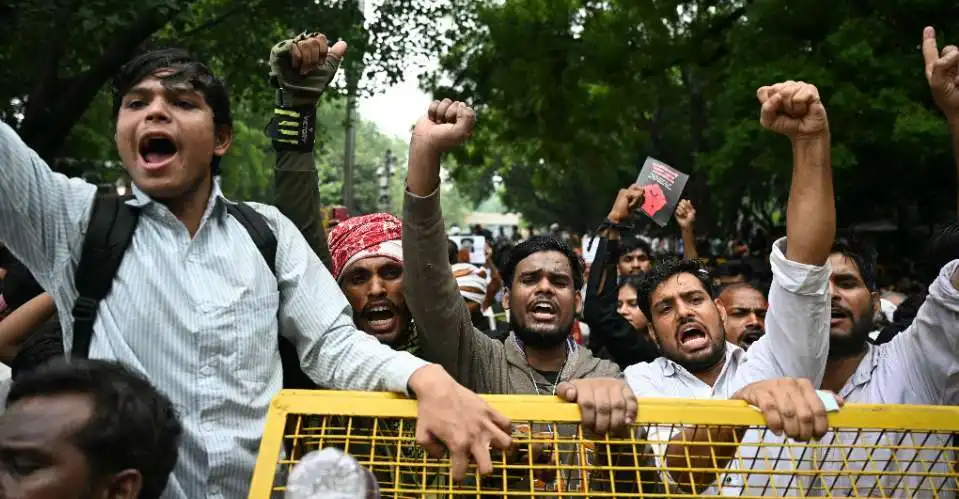
Cockroach Janta Party (CJP) supporters shout slogans at Jantar Mantar in New Delhi on July 22, 2026 during the ongoing protest to demand the resignation of India’s Education Minister Dharmendra Pradhan over alleged NEET exam irregularities. (Photo credits: AFP)
Opposition Leaders Detained Outside PM’s Residence
On July 21, police moved to clear a sit-in outside the Indian prime minister’s residence by opposition leader Rahul Gandhi and his Congress Party MPs and workers, to protest the police brutality unleashed on students in the national capital a day earlier.
Gandhi, along with his sister Priyanka Gandhi Vadra and party president Mallikarjun Kharge among other fellow parliamentarians, were demanding answers for the high-handedness from Prime Minister Narendra Modi and Federal Home Minister Amit Shah.
The area around the prime minister’s residence is a fortress for all purposes. It is a designated sensitive zone where protest is barred by law, and police detained the Congress MPs within minutes.
The Congress parliamentarians called it “BJP [Bharatiya Janata Party] terrorism” as they were led away and asked why the prime minister and home minister had said nothing while injured students lay in hospital.
That a sitting leader of the opposition can be physically removed from outside the head of government’s own house for asking why students were beaten tells the political story of Modi’s 12 years in power — a law unto himself — as much to his partymen and the citizens.
Rahul Gandhi’s message on social media, posted before the detentions began, set the terms plainly: the government refuses to take responsibility for police brutality and refuses to allow a parliamentary discussion on it. The prime minister and home minister should resign for wrecking the future of the country’s youth, he demanded.
It was Gandhi’s second confrontation with the government in as many days — the first on July 20 itself, within hours of the crackdown, when he described Modi as the most anti-youth prime minister in India’s history.
Modi’s so hostile to the young that he cannot even sack a failed education minister after 152 documented examination paper leaks that impacted 75 million students. Nobody responsible has been punished, he said. Only the students have paid the price.
Priyanka Gandhi Vadra followed with a sharper, more personal register, calling the protesters “our own children” and demanding to know why the federal government’s response to a generation’s grief was a police baton instead of a simple answer.
The Congress leadership has thus set the terms on which the current crisis will now be argued: not law and order, but accountability.
Origins of the Student Protest Movement
The crisis did not begin at the Congress’ initiative. It began on June 6 when a sit-in at Jantar Mantar, a public protest site in New Delhi, was launched by the satirical Cockroach Janata Party (CJP) led by its leader Abhijeet Dipke. It changed character when Ladakh-based activist Sonam Wangchuk joined in late June and began a fast.
But from the earliest days, it was the organised left-wing groups that gave the protest its scale and discipline. The Students’ Federation of India, the All India Students’ Association and the All India Students’ Federation supplied the numbers and the political experience that a satirical party and a lone faster could not.
Senior leaders from the Communist Party of India-Marxist — Brinda Karat, M A Baby, Vijoo Krishnan among them — joined the small crowd in person. This was, till July 20, a left-organized mobilization in the guise of a viral online movement.
Their presence meant that the government could not dismiss this as a one-man protest, which could end when Wangchuk’s health forces him to stop, or as an online fad that would lose steam once the news cycle moves on.
Many critics had suspected the CJP was a creation of the BJP and its parent body, the Rashtriya Swayamsevak Sangh (RSS or national volunteer corps), the way they were handed police permission to protest examination paper leaks amid a plethora of problems faced by Modi’s government.
The student numbers joining the July 20 march on the Indian parliament — more than 10,000 marchers, by most independent counts — were the product of left organizations’ involvement, not of any single celebrity’s draw.
The left parties in India have built durable student organizations for a century; they do not fold when a single leader tires.
The July 20 Crackdown
Delhi police, governed directly by the federal home ministry, and with a new commissioner appointed overnight, banned assembly near the national parliament. When the student marchers pushed against the barricades, they used water cannons, tear gas, and baton charges while pursuing fleeing students into the lanes around historic Connaught Place.
Five metro stations were closed, and internet was suspended in the area around parliament — a measure this government has used against Kashmir for years and now deploys against its own capital when students protest.
Dozens were injured and several hospitalized, as seen in photographs released by Marxist groups, saying they showed a government too frightened of its own youth to answer them.
Condemnation was not confined to political parties. Even the Church, silent for much of the month, spoke at last.
The Catholic Bishops’ Conference of India issued a statement on July 21 calling the police action a heartbreaking assault on the soul of Indian democracy and pledging solidarity with a generation demanding accountability.
The government granted a minimal concession, calculated to avoid the real issue. A two-member CJP delegation was received, not by Education Minister Dharmendra Pradhan, whose resignation is the central demand, but by Health Minister J P Nadda.
They handed over a memorandum asking for Wangchuk’s unconditional release, Pradhan’s removal, and compensation for the families of examination aspirants who died by suicide after the latest question paper leak, none of which were granted.
The disruption in parliament followed the same pattern. Mallikarjun Kharge, who is the Leader of the Opposition in the Rajya Sabha or upper house, raised the police action within minutes of the House convening, but it was adjourned before he had finished.
The Lok Sabha or lower house of parliament also lasted barely a quarter of an hour before Speaker Om Birla adjourned it amid opposition sloganeering.
Modi’s Response and the Political Road Ahead
Prime Minister Modi’s response confirmed exactly what the opposition has been arguing. Addressing his ruling coalition’s lawmakers, he called for a “foolproof” examination system, cited 13 arrests made in the paper leak case, among other actions, as proof his government had acted.
He even advised his MPs to guide young people towards the right path rather than provoke them.
Modi did not name the students who took their own lives after the latest paper leak, did not express any regret, nor did he acknowledge that a government promising a “robust” examination system is admitting, by that very promise, that the one it ran was not.
A prime minister who speaks of foolproof examinations while staying silent on dead students is not addressing the crisis; he is managing its optics.
Rahul Gandhi said as much within hours, telling parliament that Modi owed the students an apology for what happened on July 20 and that the testing system had “been hollowed out from within.”
The political calculation now facing the BJP is unforgiving.
International coverage has already framed the July 20 events as the largest street challenge Modi’s government has faced in its third term, while noting the shrinking space for dissent under an administration that increasingly answers protest with arrests and force rather than negotiation.
There seem only two paths from here, and both carry cost for the government.
It can concede — remove its education minister, order an independent inquiry into the leaks, compensate the bereaved families — and hand the opposition a victory it did not win at the ballot box.
Or it can treat every subsequent gathering as a security problem to be managed with barricades and tear gas, and watch a movement continue to grow.