This should reasonably prompt a federal inquiry into incitement, an opposition censure motion, or sustained national coverage
Eighteen Years Later: Odisha Moves to Honor Kandhamal’s Hindu Nationalist Leader
Eighteen years after the August 2008 pogrom against Christians in Kandhamal, the pro-Hindu Bharatiya Janata Party (BJP) government in the eastern Indian state of Odisha has announced it will memorialize the life of political and religious leader Swami Lakshmananda Saraswati in the state school curriculum.
Chief Minister Mohan Charan Majhi confirmed the decision last week at a book release in the state capital, Bhubaneswar, attended by senior functionaries of the BJP and its ideological parent, the Rashtriya Swayamsevak Sangh (RSS or national volunteers’ corps), and Swami Jeevan Muktananda Puri of the trust that published a book on Saraswati.
This was even as speakers at the commemoration events called for the elimination of Christians from the Kandhamal district — the epicenter of anti-Christian violence that followed the murder of Saraswati on Aug. 23, 2008.
A Series of State Decisions
It followed a run of related state decisions taken within days of each other — a proposal to rename the Government Medical College and Hospital in Phulbani after the slain Swami; 130 million rupees (US$1.36 million) for Jalespata Ashram, where he was killed along with his four associates; a Crime Branch inquiry into the disappearance of the files of Justice Naidu Commission’s which probed the murder; and a birth centenary campaign beginning Aug. 21, promising outreach in villages across the state.
Revisiting the 2008 Violence
Maoist guerrillas had claimed to have shot dead the Swami and his associates in 2008, but Hindu groups blamed the Christian community in the heavily forested tribal district.
What followed was one of the worst outbreaks of anti-Christian violence in independent India.
According to government reports, the violence killed at least 39 Christians, though Christian families said they counted more than 100 dead, with more than 40 women sexually assaulted, including a Catholic nun and a young Hindu woman who was employed by a Christian NGO.
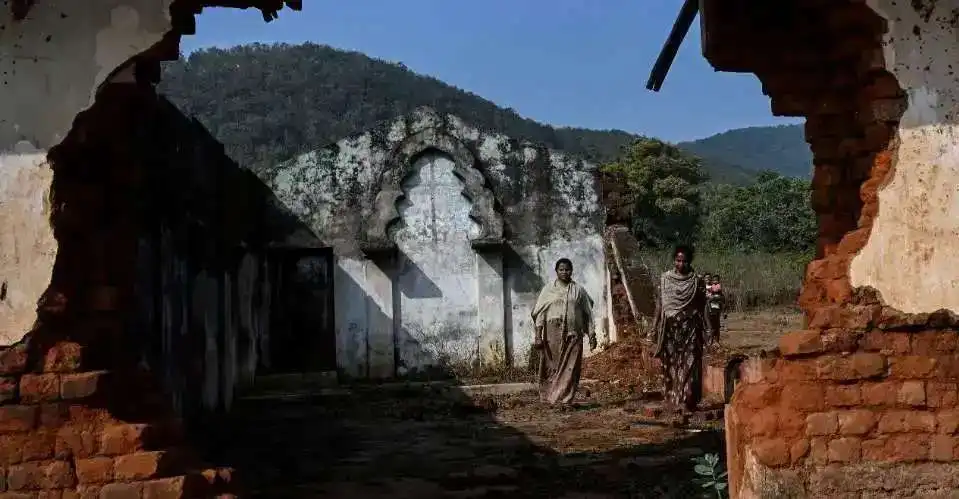
Reports indicate that more than 395 churches were razed or torched, between 5,600 and 6,500 houses plundered or burnt down, over 600 villages ransacked and some 75,000 people left homeless.
Many Christian families were burnt alive, and thousands were forced to convert to Hinduism under threat of violence.
Some Hindu families were also assaulted on suspicion of being friends with Christians, and supporters of the Indian National Congress or Congress party, the BJP’s main rival.
Convictions and a Troubled Legal Record
BJP legislator Manoj Pradhan was convicted for the anti-Christian violence in 2010 along with 18 others, while 7 Christians and a Maoist leader were convicted in 2013 for the murder of Saraswati
Prosecutions crawled through the courts for over a decade and produced a conviction rate that lawyers still call a scandal.
Questions Over the New Curriculum
The future generations of Odisha will now be taught about a man whose four decades of confrontation with Kandhamal Christians and Dalits, or formerly untouchable communities, are a matter of documented record.
It is a moot question what the new curriculum entry will say and what it will leave out.
The language at the book release went well past commemorations as the Hindu nationalist swami was put in the same league as leaders like the martyred Sikh Guru Tegh Bahadur, who was executed by the Mughal rulers, and the freedom fighter Hindu leader Swami Shraddhanand.
Calls for a “Church-Free” Odisha
Speakers spoke of completing the slain leader’s “unfinished work,” with Kandhamal as the laboratory whose model could be extended across the country. They called for a “church-free” Odisha and for curbing the activity of people they termed “vidharmis” — a term referring to Christian and Muslim citizens, implying their faith is foreign to India’s soil.
The Chief Minister’s Position
Chief Minister Majhi, who had recently supported the early release from jail of Dara Singh, the killer of the Australian Graham Stuart Staines and his two young sons, described the swami as a tribal reformer and called the Naidu Commission files, missing from the chief minister’s office, a “serious matter,” and part of a conspiracy.
Majhi and his office have so far not clarified their position on the public call for a “church-free” state — made in his presence — overriding every single Constitutional guarantee of freedom of religion and belief and the protection of the law.
Constitutional and Civil Society Concerns
The Church and community organizations have not yet reacted. Civil society activists point out that federalism exists to prevent state machinery from becoming an instrument of one organization’s project rather than the Constitution’s.
“Kandhamal Christians are entitled to ask whether that constitutional oath the chief minister took still means anything to him,” they say.
Kandhamal’s tribal and Dalit Christians have spent decades caught between RSS’ “Ghar Wapsi” or homecoming campaign, which entails conversion to Hinduism, and their constitutional right to worship as they choose.
The martyr narrative built around a death whose actual culprits were never the community being blamed is merged with an aggressive “cultural revival,” a sequence which preceded 2008 in Kandhamal.
Fears of a Repeat “Laboratory“
What worries the community most is that the call against their existence in the state came not at a party function but at one organized with the help of the state government machinery, with the chief minister in the front row.
Kandhamal Christians have reason to hear “laboratory” as a threat; they have borne its brunt in 2008.
A Wider Silence
What also concerns people well beyond Odisha’s Christians is how little scrutiny any of this has drawn from the judiciary, the police and from political circles.
A call for a “church-free” state might reasonably prompt a federal home ministry inquiry into incitement, an opposition censure motion, or sustained national coverage. The curriculum decision that followed days later has drawn barely more attention.