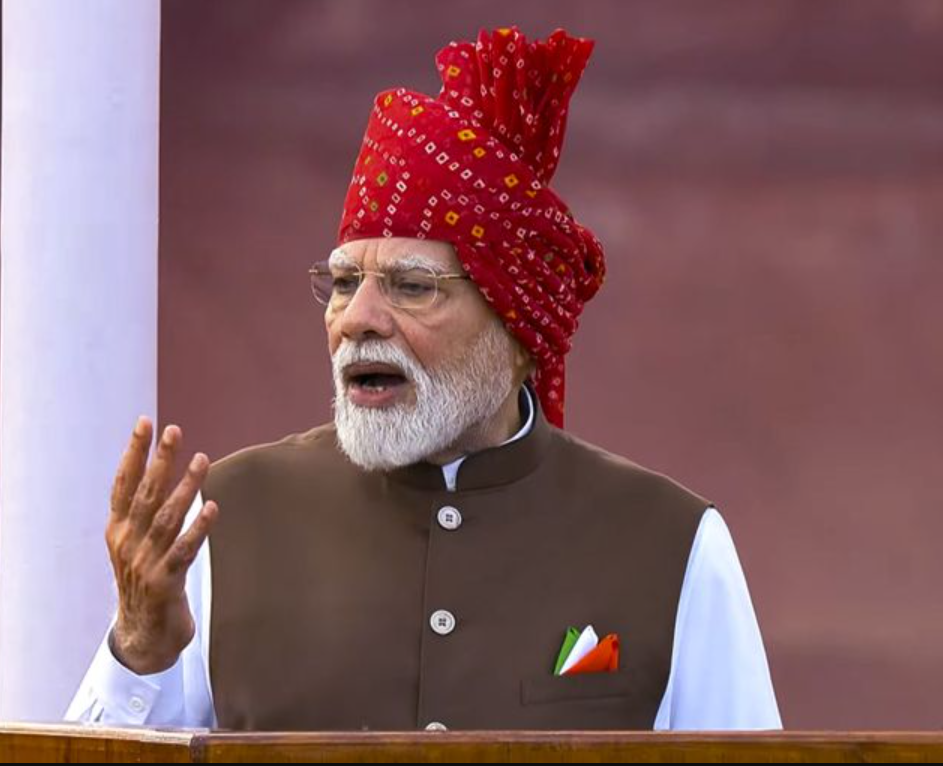
Independence Day this year will be remembered for the overwhelming iconography and sounds of the PM’s preferred Hindutva
Naming an Internal Enemy
India’s Prime Minister Narendra Modi chose his Independence Day address from Delhi’s Mughal-era Red Fort to criminalize every questioning mind in the country as an internal ideological threat, implicating everyone from university students and teachers to public intellectuals and writers.
Modi has often spoken of Naxalism and Maoism as forces that had destroyed the futures of young Indians and cast a subset of his critics as urban Naxals, a term he and his ministers have used repeatedly over the years to describe intellectuals and activists said to sympathize with Maoist thinking without taking up arms themselves.
This time he chose a colloquial Hindi term, Dimagi Naxals, which loosely translates as ideological left-wing extremists. A narrower definition, perhaps, points to those in universities and other thinkers. It is also catchier than urban Naxals.
The Red Fort’s Historic Weight
The prime minister’s address from the historic fort is the most important public event in the nation’s annual calendar, celebrating the first hoisting of the national tricolor by Prime Minister Jawaharlal Nehru, hours after his midnight announcement of independence in parliament, calling it India’s Tryst with Destiny.
Nehru set the development and humane agenda for the new nation, born in the bloodshed of Hindu-Muslim riots during Partition, which created a secular India and a Muslim-majority Pakistan.
Since then, his successors such as Lal Bahadur Shastri and Indira Gandhi and Charan Singh created landmark programs, while Atal Behari Vajpayee of the Bharatiya Janata Party (BJP) and then Manmohan Singh of the Congress addressed domestic and international issues.
Sporting his favorite turban evoking the kingdoms of the old Rajputana and projecting his 72-minute speech to the 2047 centenary of independence, Modi referred to youth as makers of the nation’s future but chose not to utter a word much less an apology on the firing of pellet guns, AK47 guns and police mauling of young women activists in Delhi’s Jantar Mantar and Bihar’s Patna protests in June-July this year.
Prime ministers in the past have used their Independence Day speeches to be more than a catalog of achievements and warnings and instead used the momentous occasion to discuss what has gone right, what has gone wrong, and what must change.
Silence on Victims and Institutions
Modi was silent on such questions, as much as his speech was devoid of any salve to people injured at the hands of the police, victims of hate crimes and mass violence, including Dalits, Tribals and religious minorities such as Christians, and Muslims who also repeatedly face the state’s heavy hand.
There was nary a word of assurance that the government was committed to protect the independence of India’s courts of law, and constitutional institutions such as the Election Commission of India, and the Information Commission.
And though he barely referred to foreign affairs and matters of diplomacy and peace in India’s troubled neighborhood and the world, Modi did focus on the need to develop drones for war, and antidotes to similar weapons in the hands of those who would want to attack India.
In a country where 800 million people depend on free rations, the prime minister offered little hope of ameliorating poverty, even in the 2047 target period.
The Economic Reality Check
He did refer in some detail to digital infrastructure, expanded roads and renewable-energy capacity, pharmaceuticals, information technology, space and services, though experts were quick to point out that he had treated the truth very lightly in claiming credit for his government’s 12 years in office.
The first, and major, unresolved question is employment, which underpins the undreamt of in India’s young men and women. Though the prime minister spoke of opportunities, he offered little concrete explanation of how the millions of productive, reasonably paid jobs required by a young population would be generated.
The International Labour Organization’s India Employment Report 2024 pointed to a troubling paradox: labor-market indicators have improved in some respects, yet educated young people remain particularly vulnerable to unemployment and poor-quality work.
India does not merely need more people counted as employed; it needs more productive, formal and adequately paid employment, with the official unemployment rate for those aged 15–29 being 10.2 percent in 2023–24
The government has repeatedly promised that India will become a global manufacturing hub, but it accounted for only about 11.4 per cent of employment in 2023–24, well below the scale required for manufacturing to become the principal engine of mass employment.
Substantial portions of the value chain, from sophisticated components to critical materials, remain dependent on imports — from semiconductors and deeper domestic capabilities in chip design, to aircraft engines.
India has sent spacecraft to the Moon and is planning an early manned space flight, but the prime minister’s address offered no institutional roadmap for making India a genuine scientific power, with a sustained increase in research spending and retaining science and technology brains in the country.
The energy transition provides another example of the gap between ambition enunciated by the prime minister and the reality, with figures from the Central Electricity Authority’s 2024–25 showing coal and lignite still accounted for roughly 73 percent of utility electricity generation, with renewables excluding large hydro contributing about 14 percent and nuclear just over 3 percent.
Economic growth presents a related contradiction, with the country’s chief executive again pointing to the country’s strong aggregate GDP growth but not retooling with the per capita income in which India ranks well down after the 125 mark of the world’s better nations.
Economists critical of this window dressing say a country does not become genuinely developed merely by growing larger in aggregate, and inequality of India’s scale means aggregate gains coexist with financial insecurity among lower-income households.
Agriculture is another area where the gap between rhetoric and lived reality is humungous, as was reflected in the restiveness of the country’s farmers who marched to New Delhi five years ago and have not been pacified by repeated government promises to double their incomes.
Farmers continue to face volatile prices, rising input costs and policy uncertainty, with export restrictions on commodities such as rice, wheat and onions reducing their ability to benefit from higher international prices.
Foreign policy was another major area not really covered in any length by Modi, though India faces a difficult strategic environment involving China, Pakistan, Russia, the United States, West Asia and the wider Indo-Pacific, requiring clear priorities, stronger regional diplomacy and a credible answer to how India intends to navigate a world increasingly divided by geopolitical rivalry.
Vision 2047 and the Politics of Optics
Viksit Bharat 2047 or making India a developed nation by the time it celebrates the centennial of its liberation from colonial rule was the core of the address, but the prime minister’s broad brush-stroke vision listed no measurable details on how many high-quality jobs will be created, possible rise in real wages, and the percentage of GDP which will be invested in research and education.
He chose to substitute past achievements and abstractions, along with warnings about ideological adversaries, for measurable answers to present anxieties, prime among them the youths’ need for jobs, not merely internships.
Modi invests heavily in making a visual impact in his public appearances and close impact on his audience in mass gatherings such as the celebrations of Independence Day at the Red Fort or the Republic Day military parade at India Gate.
Independence Day this year will be remembered for the overwhelming iconography and sounds of Modi’s preferred Hindutva.
Young people who sat in the front rows of the foreground of the fort wore white and saffron with no trace of green or blue that make the other important colors of the national flag and emblems.
The complete verses of the national song, Vande Mataram, including the controversial ones referring to religious deities, which were sung at the closing of the Monsoon session of parliament, echoed down the lawns and roads at the fort.
Bharat Mata Ki Jai, or Victory to Mother India, and Vande Mataram, or Reverence to the Motherland, are stirring slogans, but many still prefer Jai Hind, or Hail India, the official words used by India’s armed forces as a greeting, and which were used from the Red Fort by every prime minister from Jawaharlal Nehru to Manmohan Singh.