Patriotism enforced by statute and stopwatch simply means you no longer trust your citizens
Weaponizing a Song
India does not honor “Vande Mataram” — literally, I salute you, O Mother (referring to India) — by weaponizing it against citizens, as it seems to be in the manner in which the Federal Home Minister Amit Shah has conducted this month’s row over India’s national song.
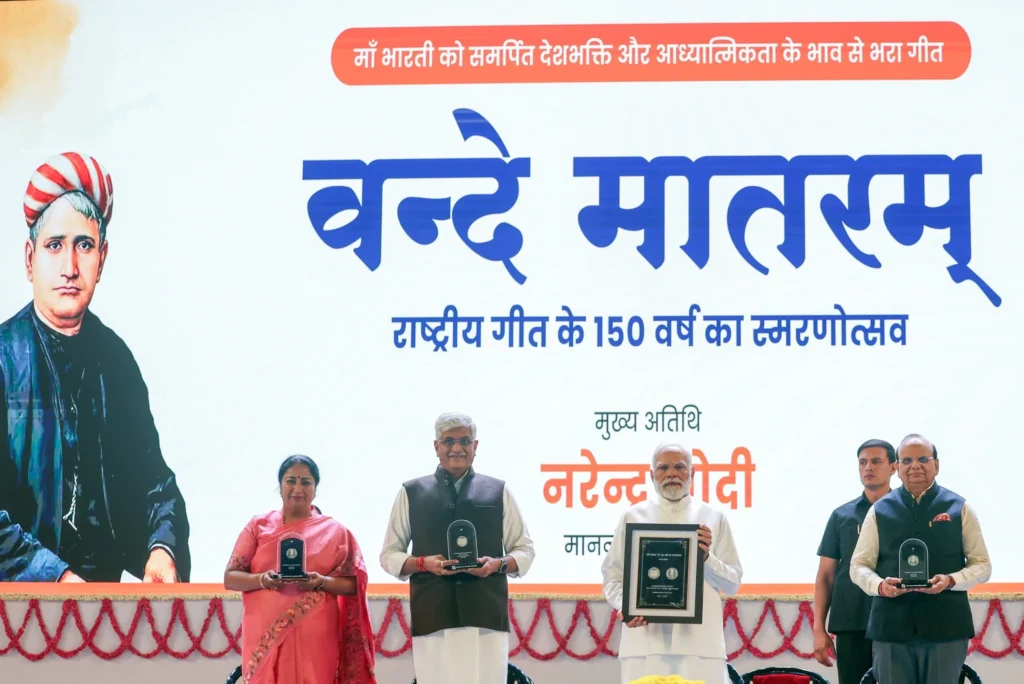
Vande Mataram was composed as part of the Bengali novel Anandamath, written by Bankim Chandra Chattopadhyaya and published in 1882. It was set against the backdrop of the late-18th-century Sannyasi Rebellion against the East India Company.
On Aug. 20, Shah described the decision by the Congress Working Committee, the opposition Congress party’s highest decision-making body, to sing only the opening two stanzas at party events as “anti-constitutional” and an act of “open defiance” of a law passed by Parliament.
By doing so, he was reviving the rhetoric of the Hindu nationalist Bharatiya Janata Party (BJP) and its ideological parent, the Rashtriya Swayamsevak Sangh (RSS, or National Volunteers’ Corps), that Congress leader and India’s first prime minister, Jawaharlal Nehru, had “divided” the song in 1937, thereby helping sow the seeds of Partition.
A Law and Its Limits
Parliament on July 30 passed the Prevention of Insults to National Honour (Amendment) Bill, 2026, after a debate in which, by most media accounts, only two members spoke.
The amended law extends to Vande Mataram the same statutory protection long enjoyed by Jana Mana Gana, the national anthem written by Nobel Laureate Rabindra Nath Tagore.
Not singing it properly, or insulting it in any way, now carries penalties of up to three years’ imprisonment,
A close examination shows that what the amended law actually criminalizes is preventing or disturbing others who wish to sing the song, while being silent on citizens, or a political party, who simply choose to sing less of it themselves.
The Congress Working Committee met in Delhi on Aug. 19 and reaffirmed the position Congress has held since 1937 that only two stanzas need be sung at its own events, instead of all six, because the rest of them seem to be in praise of deities holy to Hindus, particularly in Bengal, and may not be acceptable to monotheistic people, such as Muslims, Christians and some other sects.
The BJP replied within days with a ten-point resolution, announced by party president Nitin Nabin, pledging to protect the “honor, dignity, historical legacy and national character” of the complete six-stanza song and promising a nationwide campaign aimed particularly at younger Indians.
Congress MPs launched a social media campaign pointing out that the party was simply following the position taken in the era of Mahatma Gandhi, Nehru and Sardar Patel, who played a crucial role in shaping modern India.
Both sides, in other words, are refighting 1937 with 2026’s microphones.
Compulsion Versus the Constitution
The government’s official Protocol Order directs that all six stanzas be played at specified official events, with those present required to stand at attention, a marked departure from the 1937 convention that has governed national usage for nearly 90 years.
Legal commentators have noted that this order, and the criminal penalties now attached to disrupting the song, sit uneasily against the Supreme Court’s 1986 ruling — on an appeal by Jehovah’s Witness plaintiff Bijoe Emmanuel — which held that patriotic observance cannot be compelled against conscience, and against Articles 19, 21 and 25 of the constitution.
Tagore sang Vande Mataram at the 1896 Congress session. It became a cry of anti-colonial defiance during the agitation against the 1905 partition of Bengal, when the British prosecuted people for shouting it in public.
It was Tagore, not Nehru alone, who drew the crucial distinction that the opening stanzas invoke the motherland as land and landscape, water and fruit and fragrant wind, open to a citizen of any faith; the later stanzas identify the mother explicitly with Durga and Lakshmi, language entirely at home in Hindu devotion but difficult to ask of a Muslim, Christian, Sikh or Jain as a condition of belonging.
The committee that met on Oct 28, 1937, to settle the matter included the Congress’ top leadership, and now to insinuate that their decision was an appeasement of Muslims, or as the sole fault of one prime minister who was not even prime minister at the time, exposes the government’s dishonesty.
Congress has its own history to answer for, as its supporters overreach when they claim the RSS has never respected Vande Mataram; the organization’s own account of its founder’s early involvement with the song, and its continuing public commemorations of it, make that claim too sweeping to hold.
Equal Honor, Not Equal Compulsion
Sucheta Kripalani, the first woman chief minister of Uttar Pradesh, sang Vande Mataram at the midnight sitting of the Constituent Assembly on Aug. 14-15, 1947.
Rajendra Prasad, presiding over the assembly on Jan. 24, 1950, declared Jana Gana Mana the national anthem and Vande Mataram equal in status and honor, in recognition of its role in the freedom struggle.
That formula gave the song equal honor, not equal compulsion, and it attached no penalty to a citizen who chose not to sing it.
It is precisely that distinction, between honoring a symbol and enforcing it, that the government’s protocol order and the amended act now blur, and Shah’s language this month erases altogether.
The actress Sharmila Tagore, a kin of the Tagore family and married to legendary cricketer, the late Nawab Pataudi, made the underlying point plainly this week, saying in an interview that citizens who believe in one God cannot easily be asked to sing “Vande Kali, Vande Durga,” and that the first two stanzas alone can serve every community.
It is the same point Tagore made in 1937, restated without polemic by someone under no obligation to enter the argument at all.
Scholars note that none of this makes Vande Mataram any less a monument of the freedom struggle, and no one can stop anyone from singing all six stanzas who wishes to.
Patriotism enforced by statute and stopwatch is not stronger than patriotism freely given; it is simply patriotism that no longer trusts citizens.
Tagore trusted them. The Congress top leadership who fought for independence trusted them, but the current dispensation trusts them rather less.
That, and not the number of stanzas sung, is the real distance politics in India has traveled between Gandhi-Nehru in 1937 and Modi-Shah in 2026.