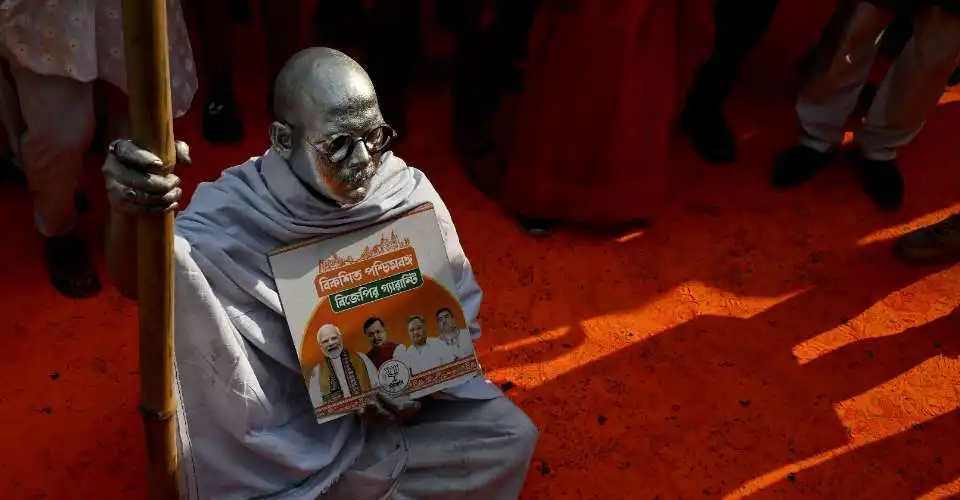
DIBYANGSHU SARKAR / AFP)
Modi sweeps three of five states, shrugs off charge of police boots, scalpel on Muslim votes
Election Results: A Sobering Verdict for 2029
The assembly election results of May 4, spanning Assam, Kerala, Puducherry, Tamil Nadu, and West Bengal, have delivered a sobering verdict on the state of Indian democracy and its course towards the 2029 national election. Two incumbent governments were retained — the Bharatiya Janata Party (BJP)-led National Democratic Alliance (NDA) in Assam for a third term and in small Puducherry — while three powerful establishments fell: Mamata Banerjee’s Trinamool Congress (TMC) in West Bengal to the BJP; M. K. Stalin’s Dravida Munnetra Kazhagam (DMK) in Tamil Nadu to actor Vijay’s Tamilaga Vettri Kazhagam (TVK); and the Left Democratic Front (LDF) in Kerala to the Congress-led United Democratic Front (UDF).
State-wise Power Shifts and Incumbency Defeats
Stalin himself suffered a shock defeat in Kolathur, losing to TVK candidate VS Babu by 15,192 votes, the first time since 1996 that he would not sit in the Tamil Nadu Assembly. With over 824 seats at stake, these state results mark the further erosion of regional party strongholds and raise pointed questions about the health of federalism, secular pluralism, opposition viability, and institutional integrity under prolonged BJP dominance and its electoral machine steered by Prime Minister Narendra Modi and Home Minister Amit Shah, with the cadres of their parent organization, the Rashtriya Swayamsevak Sangh (RSS).
In West Bengal, the BJP surged past the 148-seat majority mark, winning in 206 constituencies against the TMC’s 80, ending 15 years of Banerjee’s rule. Despite claims of a steadied vote-share gap favoring the TMC by over three percentage points in earlier phases, seat conversion heavily favored the BJP amid rural penetration and welfare delivery. Tamil Nadu witnessed a seismic disruption with TVK, contesting independently, winning 108 seats, against the incumbent DMK’s 59 seats in a fragmented Dravidian landscape. Although the victor, actor Vijay, a political newcomer, is a Christian, Stalin was long seen as a darling of the Christian community for his promises to Dalit Christians and the poor. Kerala’s UDF secured 102 seats in the 140-member assembly, ousting the LDF after a decade. Assam and Puducherry reinforced NDA control.
Voter Discontent, BJP Machinery, and the Limits of Regionalism
These defeats reflect genuine voter discontent with incumbency — the TMC’s alleged syndicate culture and violence, the DMK’s dynastic image, and LDF governance fatigue. Yet they also reveal the BJP’s formidable machinery, which included direct benefit transfers, organizational depth with RSS cadres, and narrative control. The persistence of TVK as a new regional force and the UDF’s coalition success prevent a uniform narrative of total homogenization, but the broader trend is unmistakable.
Over twelve years, the Modi-led BJP and RSS ecosystem have systematically marginalized or absorbed major regional players. The list is extensive — over a dozen regional parties across key states have all suffered decisive setbacks or co-option. This is a structural shift enabled by federal fiscal leverage, investigative agencies, and welfare bypassing state intermediaries.
Implications for Federalism and State Autonomy
The consequence for federalism is profound, as India’s quasi-federal Constitution envisions states as laboratories of democracy and counterweights to New Delhi. Powerful regional voices like Banerjee and Stalin championed state rights on Goods and Services Tax (GST), language, and citizenship, and their future absence hobbles resistance in the Rajya Sabha (upper house of the Indian parliament), Inter-State Council, and Finance Commission. A BJP government in Bengal will face local pressures, but the loss of vocal federalist voices such as Banerjee may make it easier for Modi to push his projects of “One Nation, One Election” and a uniform civil code. TVK’s rise offers a partial counter, injecting fresh Tamil assertiveness without DMK baggage.
The 2029 parliamentary polls now loom as a more direct BJP–Congress contest across much of India, with fragmented regional remnants as junior partners at best.
Secularism, Identity Politics, and Minority Concerns
The defeats of the TMC and DMK — parties that positioned themselves as secular bulwarks through minority outreach and Dravidian rationalism — highlight the limits of identity-centric strategies in India, especially when led by a single leader. In Bengal, BJP consolidation among non-Muslim voters, over 70 percent of the population, overcame the TMC’s reliance on Muslim support. For Christians, the mixed signals are concerning. Kerala offers continuity for community-run institutions, yet the BJP’s advances elsewhere amplify worries over anti-conversion legislation, foreign funding curbs, and sporadic violence.
Dalit Christians, denied benefits of affirmative action programs, officially Scheduled Caste reservations, under the 1950 Presidential Order, despite socio-economic parallels, lose influential regional advocates. Their push for inclusion faces steeper odds amid majoritarian momentum. Muslims, pivotal to the TMC’s base, confront potential policy hardening, increased government-sponsored hate campaigns, and systemic disenfranchisement.
Opposition Landscape and Congress Prospects
The Kerala victory grants Congress and its leader Rahul Gandhi a much-needed anchor and governance showcase, demonstrating his brand of politics. It counters recent national declines and could energize cadre for 2029, but scaling this requires more to reach the Hindi heartland, where it has been largely absent despite the creation of INDIA or Indian National Developmental Inclusive Alliance, a multi-party political alliance of opposition parties. With regional allies and frenemies, including Banerjee and the Left, diminished, Congress is now the default opposition, but remains structurally outmatched in organization and resources by Modi’s BJP.
Electoral Integrity and Institutional Strains
The most disquieting aspect of these elections is the doubt cast on the integrity of the process, with the Election Commission of India now at the center of that crisis. In West Bengal, the ECI’s Special Intensive Revision of electoral rolls reportedly deleted nearly 9 million names — over 10 to 12 percent of the electorate — with around 2.7 million under adjudication for so-called logical discrepancies. Critics highlight disproportionate impacts on Muslims and minorities, raising disenfranchisement concerns that no turnout figure can simply dissolve.
The West Bengal election template of roll revision mechanisms, wielded with precision against targeted constituencies, may be replicated in future elections, potentially leading to the disenfranchisement of inconvenient opponents, including Muslims and sections of tribal communities. The Supreme Court’s handling deepened the wound. Petitions for interim relief on deletions and processes were largely declined. The court upheld ECI prerogatives on staffing and praised turnout while sidestepping deeper scrutiny. Senior lawyer Dushyant Dave has said no one failed India like the judiciary did — not Modi, not Shah. His words are sweeping, but the frustration they carry reflects concerns over opaque collegium appointments, selective listings, a pendency that runs to more than 49 million cases, and an ambient perception of executive influence — observations increasingly voiced by citizens watching institutional erosion in plain sight.
Outlook: Governance, Homogenization, and Democratic Safeguards
On the positive side, if it can be so described, the decline of regionalism may streamline governance, though at the risk of advancing the RSS vision of cultural homogenization. Political pundits say the 2026 verdict is neither apocalyptic nor triumphant, but reflects voter pragmatism within a system increasingly dominated by one pole. The “Bengal model” of election micromanagement and the Supreme Court’s habitual deferral now appear embedded within the institutional structure.
Sustained public scrutiny and measured reform remain the republic’s best — and perhaps last — defenses.