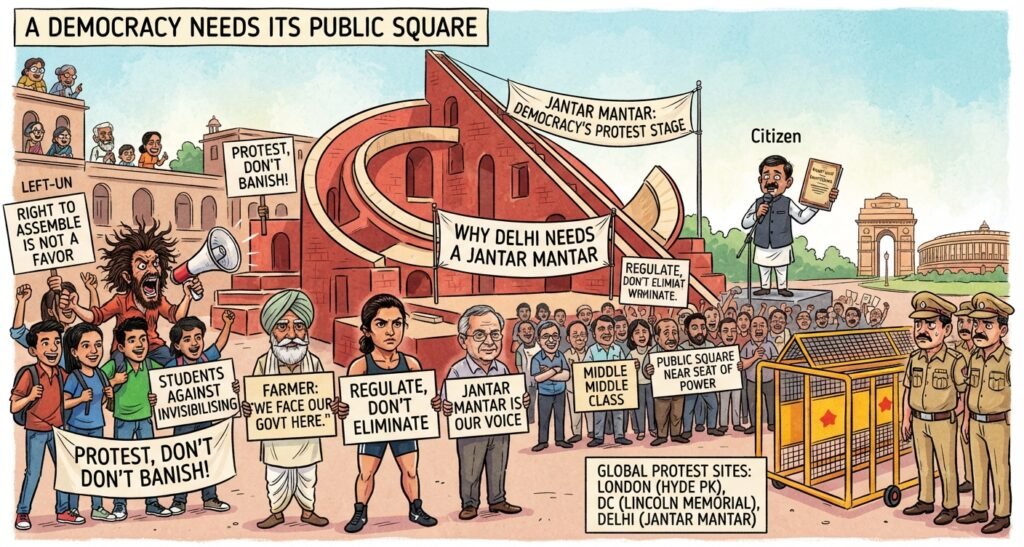
A Democracy Needs Its Public Square
England, the land of the Magna Carta, has Hyde Park and Trafalgar Square and the United States of America has the Lincoln Memorial, from which Martin Luther King Jr. made the civil rights movement echo across the world. Delhi has Jantar Mantar, and it should not give it up. Everyone agrees— government-supporting right-wing middle classes or Left-wing students—that a democracy that cannot see its own people protest, is a democracy that has begun to lose its bearings. The right to assemble is not a favour granted by the state but the breathing room of a free society which needs a place—a square, a park, a street, a monument—where grievance can be heard in the seat of power. In England, those places have been Hyde Park and Trafalgar Square. In the United States, it has been the iconic Lincoln Memorial and the National Mall. In Delhi, for three decades, it has been Jantar Mantar. Jantar Mantar was built in 1724 by Maharaja Sawai Jai Singh II of Jaipur, a king who wanted to measure the heavens, so to say. Its red brick-and-mortar instruments—the colossal Samrat Yantra, the sunken Jai Prakash Yantra, the Ram Yantra, the Misra Yantra—were designed to track stars, calculate solstices, and map time with astonishing precision. Jai Singh was not a parochial princeling but a scholar who corresponded with Jesuit scholars, drew on Indian astronomical traditions, and built five observatories across northern India. The Delhi complex was the first, a laboratory of the sky, a statement that knowledge had no boundary. Then, in the late 20th century, it became something else: a place the police could control.
From Observatory to Protest Pen
After the Boat Club, along Raj Path in the Central Vista around India Gate, was sealed off following the massive farmers’ rally of 1988, the state needed a designated site for protest. The Boat Club had been the traditional venue for public demonstrations in Delhi, a sprawling lawn with a clear view of Parliament. But the farmers’ rally led by Mahendra Singh Tikait unnerved the government. In the tense years that followed, amid the Ram Janmabhoomi movement of the 1990s and rising security concerns, the Boat Club was effectively closed to protests. The state needed an alternative, a place that preserved the symbolic right to dissent while ensuring that dissent remained within manageable limits. Jantar Mantar was close to Parliament, visible to the media, and small enough to be managed. By 1993, it had become Delhi’s principal protest venue, and a police order in 2003 formalised the arrangement, capping the number of pro testers allowed. Critics of Jantar Mantar of then point to this history and say the space was never to tally free—it was a cattle pen, not a park, but a controlled arena. But that is precisely why the current push to de-notify it and shift protests to Ramli la Ground, home to Dussehra fests and the annual burning of the effigies of Ravana and his brothers, or Burari Ground on the outskirts of the metropolis, is so dangerous as it’s tantamount to ‘in visiblising’ public opinion.
How Other Democracies Make Room for Dissent
In England, the Magna Carta did not end protest but in fact made it necessary because it set up the principle that power must be bounded by law. The people took their protests to Hyde Park, where Speakers’ Corner became a raucous theatre of free speech, and to Trafalgar Square, where Chartists, suffragettes, anti-war marchers, and generations of demonstrators have filled the square under Nelson’s Column. Parliament Square, right outside the mother of parliaments, has been the site of vigils and protests for decades. The British state has not always liked it and has arrested people, restricted them, argued over them, but it has never decided that democracy is better served by banishing protest to a far-off field. In the United States, the Lincoln Memorial is not a protest site by design, but on August 28, 1963, Martin Luther King Jr. stood on its steps and told the world, “I have a dream.” The March on Washington for Jobs and Freedom drew hundreds of thousands to the Lincoln Memorial. And from there was born the moral force of the civil rights movement flowed into American law—into the Civil Rights Act of 1964, the Voting Rights Act of 1965.
Regulate, Don’t Eliminate
America did not tell its citizens to go protest in a distant suburb, but by letting them stand in the shadow of Lincoln and speak to the nation, its democracy gave dissent a stage, letting powerless people stand within sight of the powerful who in fact heard the grievances and addressed them. Delhi’s Jantar Mantar has played that role for decades including when Anna Hazare’s anti-corruption movement filled its roads and anti-CAA protests echoed there. Women Olympian Wrestlers protesting sexual harassment camped there, as did farmers, students, workers, activists, mothers and pensioners, making the same short stretch of road between Jantar Mantar Road and Sansad Marg their temporary home. The Indian Constitution recognises the right to assemble peacefully under Article 19(1)(b), subject to reasonable restrictions under Article 19(3), which means the state has every right to regulate crowds, protect monuments and keep public order. But regulation is different from elimination, and the state can regulate crowd size, ensure security, provide water and toilets, choose timings, and protect the monument without pushing dissent to Burari. It should treat protesters as citizens, not as a nuisance, and accept that the right to assemble is not a public order problem to be solved, but a democratic principle to be protected.
If Delhi loses Jantar Mantar, it will not lose a piece of road. It will lose a symbol. It will tell its people that their voices are welcome only when they are far away, unheard, and unseen. England, the land of the Magna Carta, did not do that. America, the land of Lincoln, did not do that. India, the world’s larg est democracy, should not do that either. Delhi needs a Jantar Mantar because democracy needs a place where the people can face their government, where a farmer can stand in the shadow of an ancient sundial and ask why the laws of the land do not protect him. And a place where a student can hold a placard and know that the Parliament she is protesting is only a short walk away. Jantar Mantar was built to calculate the movement of the stars and in modern India, it now calculates the distance between the rulers and the ruled.