John Dayal, public Intellectual and though leader
The RSS has money, access, a friendly executive environment, and the weight of geopolitics on its side
The United States does not change its foreign policy because of agitations, protests, or hard campaigning directed at its embassy in New Delhi. Time and again, Washington has shown that as far as India is concerned, its vital economic and strategic interests always outweigh whatever humane elements may exist in the policy-making machines on Capitol Hill and at the White House.
RSS Campaign to Rehabilitate Its Image in the US
The Rashtriya Swayamsevak Sangh (RSS or National Volunteers Corps) — the Hindu nationalist ideological parent of the ruling Bharatiya Janata Party (BJP) — has, in the last 12 months or so, launched a major campaign with the twin target of rehabilitating itself with Christian leaders in the Bible belt, New York and Chicago, close to power in Washington, and to bolster the image of the organization.
The RSS operates in the US through its international wing, the Hindu Swayamsevak Sangh (HSS). In 2025, it operated 267 shakhas (branches or local units where dedicated volunteers meet daily) across 33 states in the US.
Counter-Campaign by Christian Groups
In a mirror image, groups of Indian evangelical leaders and their American friends have redoubled their efforts to impress upon the US administration that the RSS is the source of rhetorical persecution of Christians in India, and should possibly be banned as a violent foreign political entity.
Historical Context of US Visa Denial to Modi
The RSS remembers that Narendra Modi himself was denied a visa to enter the United States for nine years from 2005, when he was chief minister of Gujarat till May 2014, when he assumed the prime minister’s office, for presiding over the genocide of Muslims in the state in 2002.
RSS Lobbying Efforts and Controversy
The RSS is now vigorously targeting Congress, the State Department, and the institutions that shape United States policy toward India.
On Jan. 16, 2025, Squire Patton Boggs — one of Washington’s largest lobbying firms — registered as a lobbyist for the RSS. It was hired for “US-India bilateral relations” and “introducing the RSS to US officials,” and in just the first three quarters of 2025 alone, received US$330,000 for this work.
Four lobbyists were listed in the official congressional disclosure documents: Bradford Ellison, Ludmilla Kasulke, Bill Shuster — a former Republican congressman from Pennsylvania who served from 2001 to 2019 — and Rebekah Sungala, a former staffer in his congressional office.
Squire Patton Boggs had not registered its RSS lobbying under the Foreign Agents Registration Act — the 1938 law that requires transparency from those representing foreign interests before the US government. Public records confirmed that no FARA registration had been filed.
The political controversy was compounded by the fact that the same firm was simultaneously on the payroll of the government of Pakistan.
The investigative outlet Prism published its findings in November 2025, but the RSS denied that the organization had engaged any lobbying firm in the United States, after which Squire Patton Boggs terminated the contract and amended its filings.
RSS Shifts to Direct Diplomacy and Academic Outreach
The RSS changed tactics, and as its general secretary, Dattatreya Hosabale, said, it had arranged foreign trips — to the United States, United Kingdom, and Germany — to counter perceptions that it is a paramilitary outfit involved in attacks on minority communities, particularly Muslims and Christians.
The tour took place in April this year. In the United Kingdom, from April 10 to 15, Hosabale spoke at Chatham House, the Royal Institute of International Affairs, and addressed academic roundtables that included researchers from Oxford, University College London, University of Sussex, the London School of Economics, Cambridge, and the School of Oriental and African Studies.
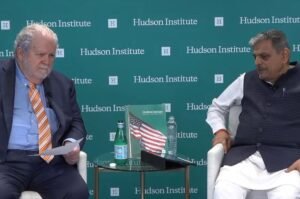
In the United States, the centerpiece was Washington. On April 23 — fifty days after the US Commission on International Religious Freedom (USCIRF) had named the RSS as part of its demand for sanctions — the Hudson Institute hosted Hosabale for a solo fireside chat with Walter Russell Mead, the institute’s Ravenel B Curry III Distinguished Fellow.
He also gave a detailed interview to National Public Radio, conducted at the Hudson Institute by NPR’s Rob Schmitz, in which he laid out the organization’s ideological position and responded to criticism.
USCIRF Recommendations and State Department Inaction
The USCIRF’s 2026 annual report recommended targeted sanctions against the RSS and India’s external intelligence agency, the Research and Analysis Wing (RAW), citing severe violations of religious freedom.
The American premier religious freedom agency proposed freezing assets linked to these organizations and restricting their members from entering the US, and designating India as a Country of Particular Concern.
The State Department has not acted on the designation in any of the previous six years.
RSS Leverages Indian-Origin Officials in Trump Administration
The RSS has also reached out to the Trump administration’s unprecedented number of Indian-origin officials in senior positions — Kash Patel at the FBI, Harmeet Dhillon heading the Civil Rights Division at the Department of Justice, Sriram Krishnan, the Senior AI Policy Advisor, and Jay Bhattacharya at the National Institutes of Health.
None of them speaks for the RSS, but their collective presence creates an environment in the executive branch that is instinctively sceptical of campaigns targeting Hindu nationalist organizations, and one in which diaspora voices sympathetic to the RSS find ready access.
Christian and Human Rights Activist Engagement
Many Indians have testified before the USCIRF hearings in Washington soon after it was formed, and Indian Christian leaders, especially those from the independent churches, have given testimony.
They and other human rights activists have also engaged with UN Special Rapporteurs and civil society leaders and politicians in Switzerland, Germany, the United Kingdom, Canada, and the United States on questions of caste discrimination and minority rights.
Allegations of Financial Choke on Christian Institutions
The current campaign in Washington argues that the RSS and the Modi administration are using a financial choke against Christian churches and institutions through the Foreign Contribution Regulation Act (FCRA) as part of the strategy to ban evangelization in India, a move already apparent in the 12 states that have enacted and enforced anti-conversion laws.
During the past decade, the government has revoked or suspended FCRA registrations of more than 20,000 organizations. Reports indicate that more than 70 percent of NGOs whose licenses expired as of January 2022 and were not renewed were aligned with Christian programs.
The government canceled the FCRA licenses of the Church of North India Synodical Board of Social Service, the Voluntary Health Association of India, the Indo-Global Social Service Society, the Church’s Auxiliary for Social Action, the Evangelical Fellowship of India, World Vision India and Compassion International.
Recent amendments proposed to the law seek to seize Christian properties meant for the Dalit or formerly untouchable, and tribal communities.
Documented Hostility and Evangelical Response in the US
According to the Evangelical Fellowship of India, 747 verified incidents of hostility against Christians were recorded in 2025, compared to 640 in 2024.
USCIRF documented one attack in Andhra Pradesh in which Hindu nationalists assaulted a minibus of evangelical Christians, beat the passengers with cricket bats and stones, and set the vehicle on fire.
This documentation feeds directly into the American evangelical network. Organizations including International Christian Concern, the National Association of Evangelicals, and the Southern Baptist Convention’s Ethics and Religious Liberty Commission maintain their own tracking of events in India and have constituencies in every Republican-leaning state.
At a USCIRF hearing on Capitol Hill last month, former US Ambassador-at-Large for Global Criminal Justice Stephen Rapp called for “methods that have a bite to them” and urged heightened documentation of violators to build cases against them for possible future international prosecution.
Conclusion: Strategic Interests Trump Religious Freedom Concerns
However, the State Department has consistently placed India’s strategic value — as a counterweight to China in the Indo-Pacific — above its religious freedom record.
The RSS has money, access, a friendly executive environment, and the weight of geopolitics on its side, and for the moment seems able to counter the evangelical campaign.