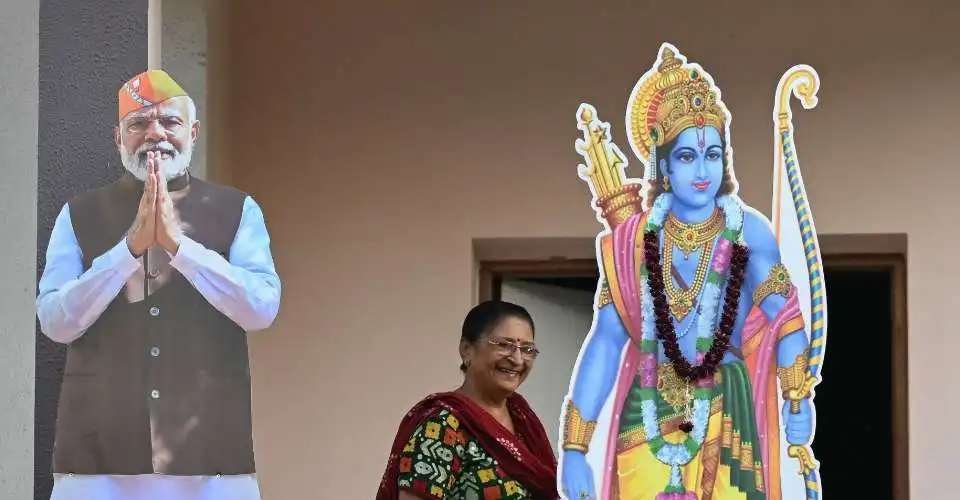
A woman stands on the balcony of a residential building with cut-outs of India’s Prime Minister Narendra Modi and Hindu god Ram, in Ahmedabad during the national election in May 2024. (Photo Credit: AFP)
By John Dayal, Public Intellectual, Thought Leader, Writer
https://johndayal.com
Final Buttons Pressed: Polling Concludes in West Bengal and Other States
The final buttons were pressed on the Electronic Voting Machines (EVMs) at dusk on April 29, completing the two-phase polling in India’s West Bengal state and bringing down the curtain on assembly elections across five states and one Union Territory.
The media and informal stock markets lit up once again with exit poll projections, though counting of votes is set for May 4, and the results will decide the fate of many political bigwigs.
Exit Poll Projections Across States
Indian news television painted a picture of flux: potential gains by Prime Minister Narendra Modi’s National Democratic Alliance (NDA) in West Bengal, challenging three-term Chief Minister Mamata Banerjee’s Trinamool Congress (TMC) party.
In the southern state of Tamil Nadu, Chief Minister M K Stalin’s Dravida Munnetra Kazhagam (DMK or Dravidian Progressive Federation) faced erosion with the debut of popular film actor Vijay’s party.
Modi’s Bharatiya Janata Party (BJP) was projected to consolidate its position in Assam in the northeast region, while the Congress-led United Democratic Front (UDF) had an edge over the Left-ruled Kerala in southern India.
The NDA was slated to retain Puducherry, a tiny area under direct federal rule, located on the western coast, surrounded by Tamil Nadu.
Reliability of Exit Polls: A Questionable Track Record
Before any of these projections are entertained as harbingers of change, a plain question must be asked: Do Indian exit polls deserve the weight assigned to them? The answer, on the evidence of their track record, is an emphatic no.
Modi, the solitary politician, has revelled unperturbed in a system that observers say he has honed with election micromanagement, hate campaigns, and subjugation of constitutional entities such as the Election Commission (EC).
The 2004 national elections saw almost every poll survey agency predict NDA comfort, only for the Congress-led United Progressive Alliance (UPA) to surge to power.
In 2021, the overwhelming consensus among pollsters called a close Bengal contest or an outright BJP edge, but Banerjee’s TMC won 213 seats in a 294-member House.
In the 2024 national elections, NDA forecasts of 350-plus seats in parliament collapsed to roughly 290.
These are not isolated accidents, but systemic failures that repeat with metronomic regularity because of methodological reasons that range from tiny polling samples compared to the real voting strength of an assembly constituency, the bewildering cross-currents of caste, religious, linguistic, and a slant by the urban media towards dominant-caste voices, ignoring religious minorities, tribal people, and Dalits (formerly untouchables).
Satta Bazar and the Business of Projections
Raw data, stratification details, and confidence intervals remain proprietary secrets. Unlike academically rigorous work, commercial polling agencies prioritise TRP ratings and narrative fit. Their projections create the most excitement — and the most damage — in India’s informal betting markets.
These illegal, underground markets are what Indians call the Satta Bazar, a sort of stock exchange of political wagering that doubles, through derivatives and algorithmic funds. Traders and brokers bet billions of rupees on projected seat tallies within minutes of the embargo lifting, swinging the Sensex in a pre-results frenzy.
High-profile punters ride the Modi wave or regional resilience narratives, turning projected electoral moods into genuine financial windfalls. New billionaires are minted overnight while political parties, opposition strategists, and a hyper-ventilating media lose sleep over projections that may prove worthless by the morning of May 4.
It is a spectacle that generates wealth for a few and anxiety for many, whilst contributing precisely nothing to the democratic process.
Voter Roll Revisions and Paramilitary Deployment
No exit poll adequately captures deceptions introduced by the recent Special Intensive Revision (SIR) of voter rolls — justified by the EC as removing deceased voters, duplicates, and so-called infiltrators — that deleted over nine million names from West Bengal’s electoral rolls alone, representing roughly twelve per cent of the state’s 76-million electorate.
Critics, including opposition leaders and legal observers, allege systematic targeting of Muslim and minority voters in TMC bastions. Hundreds of thousands of cases were left unresolved before overburdened appellate tribunals when polling day arrived. Net deletions in several key states exceeded 10 percent of registered voters, shrinking the very sampling frame that polling agencies draw upon.
In multiple constituencies across Bengal and Tamil Nadu, the scale of voter deletions exceeds the historical winning margins, tilting apparent voting strength before a single ballot is counted.
Compounding the SIR controversy is the unprecedented paramilitary deployment, particularly in West Bengal. A record deployment of Central Armed Police Forces was ordered for the Bengal phases, with armored vehicles patrolling sensitive districts and the force-to-voter ratio in Phase One of polling approaching an armed constable for every 100 to 150 voters.
These armed policemen will remain long after the results are announced, quelling any potential protest.
Banerjee publicly questioned whether this constitutes security or intimidation, echoing post-poll violence concerns from 2021 but on a vastly amplified scale. In a state with a long history of booth-level muscle, such a presence could suppress turnout among TMC-leaning voters or deter quiet anti-incumbency expression.
Potential Outcomes and Implications for National Politics
If the projections prove broadly correct on May 4 — and that is a large assumption hedged with profound caveats — the national landscape would reflect incremental BJP-NDA expansion tempered by regional resistance rather than outright dominance of New Delhi.
Assam would see the BJP-led NDA extend Himanta Biswa Sarma’s tenure as the chief minister. Puducherry would offer the alliance a symbolic southern foothold.
For Modi, the scenario represents nothing to lose and everything to gain. Having concluded an intense Bengal campaign, he was photographed on April 28 playing football with youngsters in the Himalayan town of Gangtok.
The optics were of a leader untroubled by mid-term uncertainty. Modi’s personal brand remains insulated from state-level verdicts; any BJP gains in Bengal would be credited to him personally, building on the 77 seats won in 2021, whilst losses could be attributed to local alliance failures.
Opposition Prospects and Federalism Concerns
Rahul Gandhi and the Congress remain marginal players in four of the five states: negligible in Bengal, arithmetically limited in Tamil Nadu’s alliance configuration, irrelevant in Assam, and minor in Puducherry.
Yet a possible validated UDF victory in Kerala offers the opposition INDIA bloc a genuine morale injection. It would vindicate Gandhi’s Save the Constitution campaign in at least one bipolar southern contest, energize a demoralized cadre, and provide organizational proof-of-life after the setbacks of 2024.
Such a victory would also be a signal that perhaps India is slowly reverting back to a bipartisan polity, as it used to be in the first four decades of the republic.
The important caveat is that a Kerala win would derive primarily from anti-LDF incumbency fatigue rather than any national anti-BJP wave, a distinction that pollsters don’t tell.
The fate that matters most to the future shape of Indian federalism is not that of Congress but of the Trinamool Congress. Exit polls leave the TMC’s position in genuine doubt: projections range from narrow retention to significant seat loss.
A diminished or ousted TMC would eliminate one of the most vocal and consistent checks on central authority, accelerating the BJP’s eastern consolidation.
If TMC retains even narrowly, Bengal’s Bangla pride resistance endures; outright defeat risks splits, defections, and prolonged street agitation.
In Tamil Nadu, DMK’s projected contraction — even if it retains power — signals the Dravidian duopoly fatigue and forces the party into an ideological rethink against an advancing Hindutva politics.
Threats to Indian Federalism and Democracy
For Indian federalism, the future looks fraught. More state governments in thrall to the BJP facilitate what might be called cooperative centralism: coordinated implementation of the Uniform Civil Code pilots, One Nation, One Election legislation, and National Education Policy revisions affecting minority institutions.
Residual TMC and DMK resistance would ensure pushback on fiscal devolution, delimitation methodology, and language policy.
Instruments that Modi and federal home minister Amit Shah have already deployed — SIR. Should both TMC and DMK be routed, the path clears for a systematic application of these instruments. Enhanced SIR.
The cumulative effect would threaten the democratic, federal, republican, and secular India that has been built, imperfectly but genuinely, over nearly eight decades since independence. Institutional safeguards — the neutrality of the Election Commission, the independence of the judiciary, the autonomy of constitutional bodies — would face unprecedented strain.