Summary of FCRA and Concerns over Foreign Funding Regulations for NGOs
Part-4 | Q & A
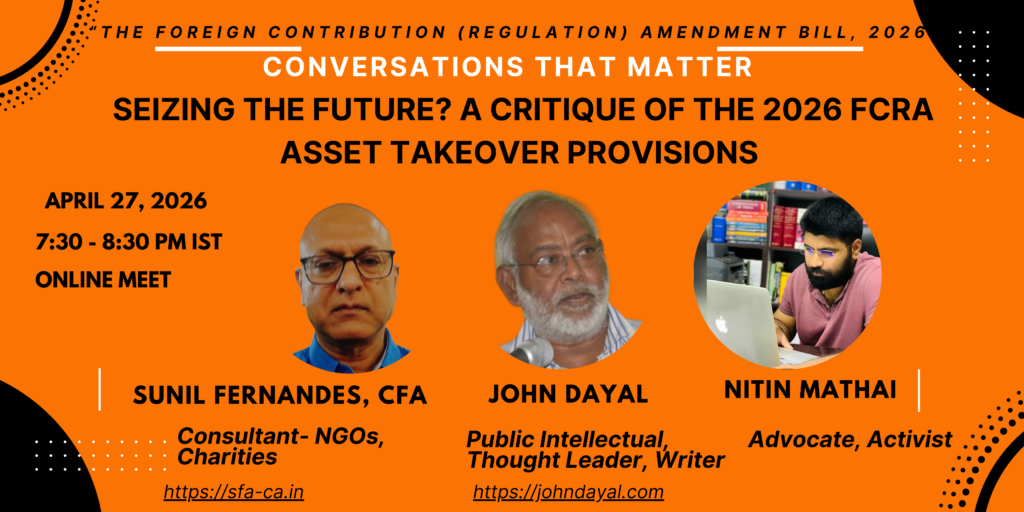
John Dayal, Sunil Fernandes, and Nitin Mathai
In this Part 4 Q&A session on The Foreign Contribution (Regulation) Amendment Bill 2026, veteran public intellectual John Dayal, along with Sunil Fernandes, CFA, and advocate-activist Nitin Mathai, address pressing questions from NGOs, churches, and civil society organizations facing the harsh new regulations.
The discussion opens with the critical issue of foreign funding dependency. John Dayal explains why Indian churches and Christian NGOs rely heavily on overseas contributions. He describes the Indian Christian community as largely poor and lower-middle class, with limited capacity for local fundraising. Unlike some other communities, there is no strong tradition of large-scale local donations or tithing. Foreign funds, he argues, are essential for running schools, hospitals, orphanages, and development work in remote villages where government services often fall short.
Panelists then tackle practical compliance challenges for small and medium-sized trusts that cannot afford dedicated legal or accounting teams. Sunil Fernandes offers clear, actionable advice: maintain completely separate bank accounts and accounting records for FCRA (foreign) funds and local/domestic funds. Even shared expenses must be properly apportioned and documented. He emphasizes that basic but rigorous bookkeeping, supported by a knowledgeable chartered accountant, is sufficient for most small organizations.
A major concern raised is how to handle past compliance gaps. Nitin Mathai stresses the importance of proactive documentation. Organizations should anticipate potential issues in expenditures and assets, prepare strong records in advance, and immediately inform authorities in case of delays (for example, due to technical glitches). If needed, approach the courts for directions to allow compliance. The panel repeatedly advises treating FCRA operations with the same seriousness as a private limited company — maintaining impeccable paperwork to avoid penalties or cancellation.
The conversation also covers the broader future of civil society under the tightened FCRA regime. John Dayal acknowledges that FCRA laws have grown stricter across governments. He calls for unified action involving not just churches but all civil society groups working with marginalized communities such as Dalits, tribals, women, and the disabled. Strategies include building political pressure through MPs, engaging international donors who have a stake in proper fund utilization, and pushing for judicial oversight and an independent appellate mechanism to reduce arbitrary decision-making.
The panel highlights fears surrounding the asset takeover provisions in the 2026 amendments, which could allow government control over properties, institutions, and assets built with foreign contributions if registration lapses or is cancelled. They urge organizations to prepare thoroughly and challenge unconstitutional aspects of the bill in court once it becomes law.
This Q&A session addresses survival strategies while maintaining a firm critique of excessive regulation that threatens the autonomy and charitable work of NGOs and religious organizations in India.
Whether you run a small trust, church institution, or larger NGO, this episode provides valuable insights into compliance best practices, risk mitigation, and collective advocacy under the proposed FCRA 2026 framework.