Summary of FCRA and Concerns over Foreign Funding Regulations for NGOs
Part-3 | The Legal Shield
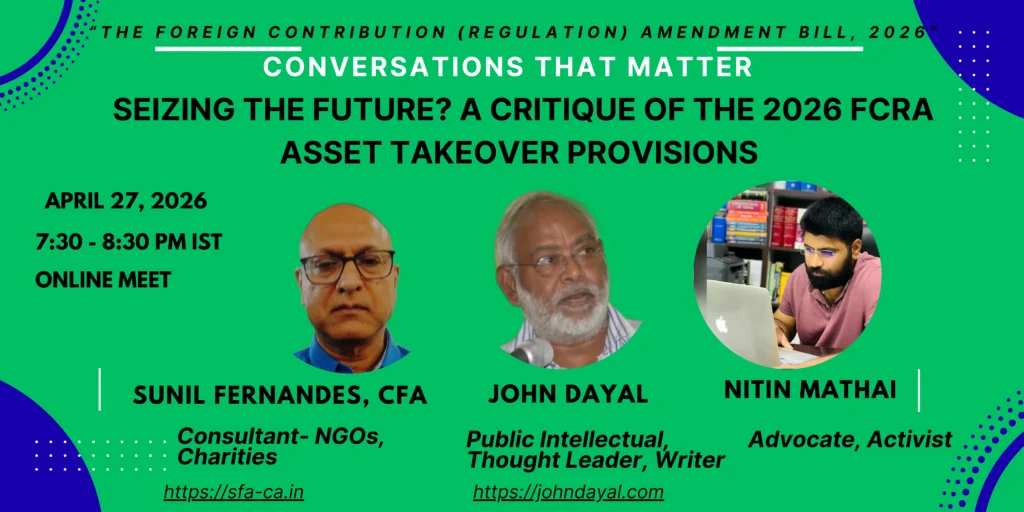
Nitin Mathai, Advocate, Activist
In Part 3 of the series on the FCRA Amendment Bill 2026, Advocate Nitin Mathai provides a legal perspective on how NGOs and charities receiving foreign contributions can build a defensive “legal shield” against the stricter provisions of the new law.
Adv. Mathai opens by explaining the government’s underlying intention behind the amendments. He states that the bill is designed to significantly reduce the number of active NGOs in India. The authorities are likely to justify actions under broad and hard-to-challenge grounds such as “national interest” and “national security.” This makes legal contestation difficult, as courts often defer to the government on such matters.
A major focus of the talk is on proactive legal strategies. The advocate strongly recommends that NGOs adopt a preemptive approach rather than waiting for show-cause notices or cancellation proceedings. He advises organizations to send formal representations (letters) to the concerned authorities before any adverse action is initiated. These representations should clearly explain genuine difficulties in meeting compliance requirements — such as exceeding the 20% administrative overhead limit — and outline the steps being taken to rectify the situation. Creating such a contemporary paper trail demonstrates good faith and can serve as strong evidence if the matter reaches court.
Adv. Mathai emphasizes that meticulous documentation is critical. If an NGO anticipates procedural violations or faces genuine operational challenges, it should proactively communicate with the government, requesting approvals or alternative compliance pathways. He notes that once government action begins, the position of the NGO becomes significantly weaker.
The speaker also discusses the severe consequences of non-compliance. Under the new rules, any violation — even procedural — can lead to cancellation of the FCRA registration. Upon cancellation, surrender, or revocation, all foreign contribution-related assets, funds, and properties automatically vest with a designated government authority. This includes movable and immovable assets created using foreign funds. He points out that allegations or prosecutions against any member of the organization (not just the governing body), particularly under state anti-conversion laws, can trigger cancellation even without a final conviction.
On the procedural front, Adv. Mathai advises NGOs to challenge unreasoned or arbitrary orders in court. He reminds viewers that revocation orders must be reasoned and must follow principles of natural justice. If the government fails to follow due process, courts can be approached to direct authorities to follow proper procedures.
One limited “silver lining” mentioned is the creation of a single designated authority for FCRA matters. While the overall intent of the bill appears restrictive, this central authority provides NGOs with one clear point of contact both for seeking clarifications and for contesting asset takeovers or cancellations.
Throughout the session, Adv. Mathai maintains a realistic tone. He acknowledges that the amendments give wide discretion to the government and are particularly challenging for faith-based and smaller NGOs. He fully supports the compliance discipline advised by CA Sunil Fernandes in earlier parts of the series and urges organizations to combine strong internal documentation with timely legal communication.
In conclusion, the core message of “The Legal Shield” is clear: NGOs must shift from a reactive to a highly proactive mindset. By maintaining detailed records, issuing preemptive representations, and being prepared to approach courts on procedural grounds, organizations can strengthen their position and reduce the risk of sudden registration cancellation and asset seizure under the FCRA Amendment Bill 2026.